
Understanding SIBO Breath Testing

Breath testing is one of the most common ways to evaluate suspected small intestinal bacterial overgrowth (SIBO). It is non-invasive, widely available, and relatively easy to perform. But like any diagnostic tool, its value depends on how it is used and interpreted within the broader clinical picture.
Understanding how breath tests work and how results are evaluated alongside symptoms and medical history can help ensure they provide meaningful insight.
How Breath Tests Work
Before understanding which breath test your doctor may order, it helps to understand what the test is actually measuring.
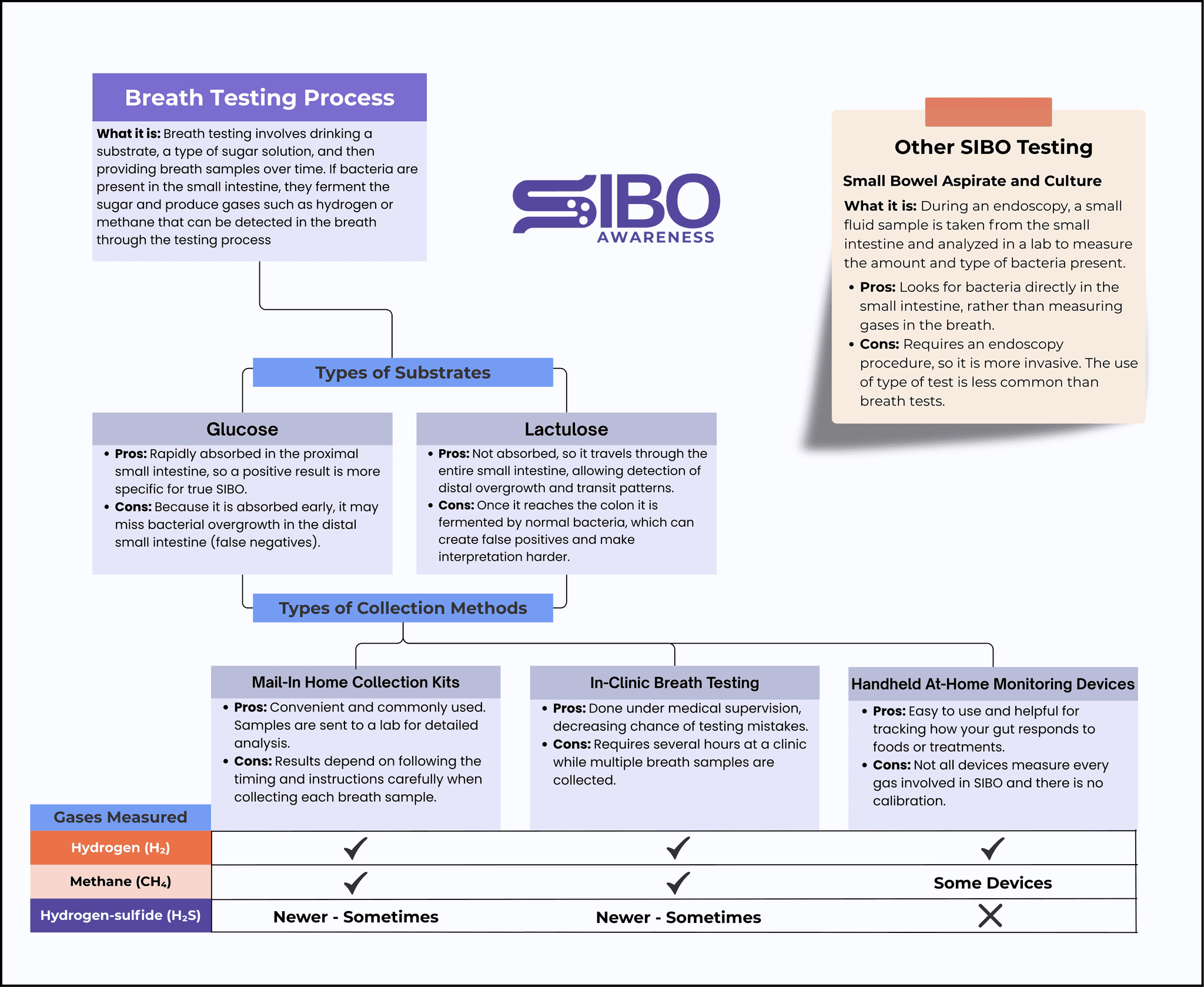
Breath tests do not measure bacteria directly. Instead, they measure gases produced when microbes in the gut ferment certain carbohydrates during digestion.
In a healthy small intestine, bacteria are present in relatively low numbers. In a person with SIBO, bacteria are present in excess. As food moves through the digestive tract, these extra bacteria begin fermenting it sooner and in greater amounts than normal. The result can be increased gas and symptoms such as bloating, diarrhea, constipation, or abdominal pain.
Breath testing works by detecting this early increase in gas.
During the test, a person drinks a sugar solution. If excess bacteria are present in the small intestine, they ferment that sugar and produce gases before the substrate reaches the colon. Those gases move into the bloodstream, travel to the lungs, and are released in the breath, where they can be measured.
Breath tests may measure up to three gases:
Hydrogen (H₂)
Methane (CH₄)
Hydrogen sulfide (H₂S)
Different gases are often linked with different symptom patterns. Hydrogen is commonly associated with diarrhea-predominant symptoms, methane with slower transit and constipation, and hydrogen sulfide with diarrhea, urgency, and abdominal pain.
These gases can also interact. Some microbes use hydrogen to produce methane or hydrogen sulfide, which means hydrogen levels may appear lower even when overgrowth is present. For this reason, measuring multiple gases can provide a more complete picture.
Because different microbes produce different gases, breath testing can sometimes reveal symptom patterns linked with specific gases.
Breath Gases and Common Symptom Patterns
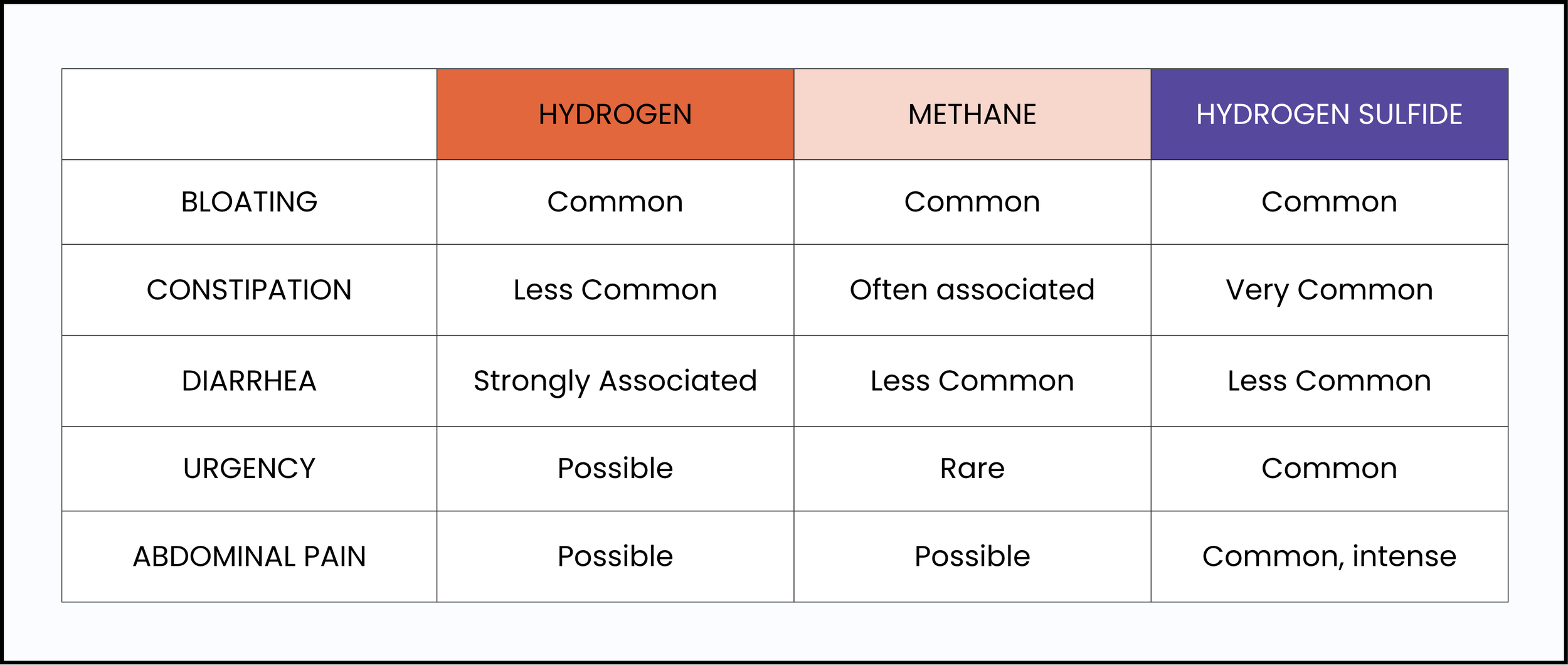
Many patients have more than one elevated gas. In large studies, overlapping gas patterns were common, especially when hydrogen sulfide was present.
Glucose vs. Lactulose Breath Tests
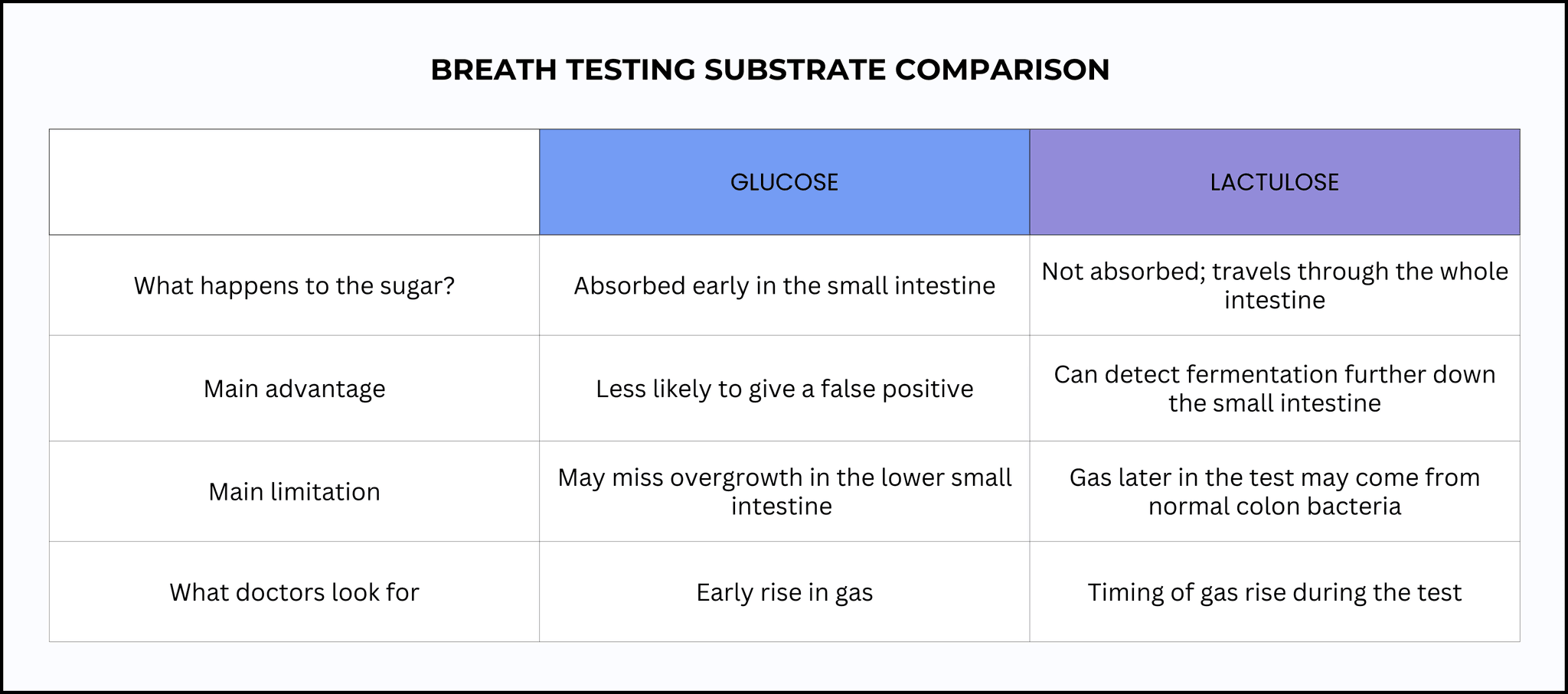
Breath tests measure gases produced when microbes ferment a test sugar. The two most common sugars used are glucose and lactulose. These sugars behave differently in the body, affecting where fermentation can occur during the test.
Glucose is absorbed quickly in the upper part of the small intestine. Because of this, a positive glucose breath test usually reflects fermentation happening in the upper portion of the gut. However, a negative test does not completely rule out overgrowth further down, because glucose may be absorbed before it reaches that part of the small intestine.
Lactulose is not absorbed in the small intestine. Instead, it travels through its entire length and eventually reaches the colon. Because of this, lactulose testing can detect fermentation anywhere along the small intestine.
However, once lactulose reaches the colon, the normal bacteria there ferment it. This means that a rise in gas later in the test may reflect normal activity in the colon rather than bacterial overgrowth in the small intestine.
Getting the Diagnosis Right
Breath testing is a helpful tool for understanding what may be happening in the small intestine, but like any test, it works best when used thoughtfully.
Choosing the right type of test, preparing carefully, and interpreting the results in context all play an important role in getting reliable answers. Breath tests do not tell the whole story, but when combined with symptoms and medical history they can provide valuable insight.
If your doctor recommends breath testing, following the preparation instructions and understanding how the test works can help ensure the results are as accurate and useful as possible.
References
Dahlgren, A., et al. (2025). Refined lactulose hydrogen breath test for small intestinal bacterial overgrowth subgrouping irritable bowel syndrome with low and high breath hydrogen. Gastroenterology Research and Practice, 2025, 5597071. https://doi.org/10.1155/grp/5597071.
Ghoshal, U. C. (2011). How to interpret hydrogen breath tests. Journal of Neurogastroenterology and Motility, 17(3), 312–317. https://doi.org/10.5056/jnm.2011.17.3.312.
Kashyap, P. C., et al. (2024). Critical appraisal of the SIBO hypothesis and breath testing: A clinical practice update endorsed by the European Society of Neurogastroenterology and Motility (ESNM) and the American Neurogastroenterology and Motility Society (ANMS). Neurogastroenterology & Motility, 36(6), e14817. https://doi.org/10.1111/nmo.14817.
Mattsson, J., et al. (2017). Outcome of breath tests in adult patients with suspected small intestinal bacterial overgrowth. Gastroenterology and Hepatology from Bed to Bench, 10(3), 168–172..
Nichols, B. L., Baker, R. D., & Baker, S. S. (2020). Overview of breath testing in clinical practice in North America. JPGN Reports, 2(1), e027. https://doi.org/10.1097/PG9.0000000000000027.
Pimentel, M., et al. (2020). ACG clinical guideline: Small intestinal bacterial overgrowth. The American Journal of Gastroenterology, 115(2), 165–178. https://doi.org/10.14309/ajg.0000000000000501.
Rezaie, A., et al. (2017). Hydrogen and methane-based breath testing in gastrointestinal disorders: The North American consensus. The American Journal of Gastroenterology, 112(5), 775–784. https://doi.org/10.1038/ajg.2017.46.
Roland, B. C., et al. (2015). Small intestinal transit time is delayed in small intestinal bacterial overgrowth. Journal of Clinical Gastroenterology, 49(7), 571–576. https://doi.org/10.1097/MCG.0000000000000257.
Scalese, G., et al. (2025). Diagnostic evaluation of small intestinal microbial overgrowth: A cross-sectional comparison of glucose and lactulose breath tests. Journal of Clinical Medicine, 14(24), 8920. https://doi.org/10.3390/jcm14248920.
Tansel, A., & Levinthal, D. J. (2023). Understanding our tests: Hydrogen-methane breath testing to diagnose small intestinal bacterial overgrowth. Clinical and Translational Gastroenterology, 14(4), e00567. https://doi.org/10.14309/ctg.0000000000000567.
Villanueva-Millan, M. J., et al. (2025). Hydrogen sulfide and methane on breath test correlate with human small intestinal hydrogen sulfide producers and methanogens. Digestive Diseases and Sciences, 70(11), 3846–3856. https://doi.org/10.1007/s10620-025-09156-y.